Allele loss under selection¤
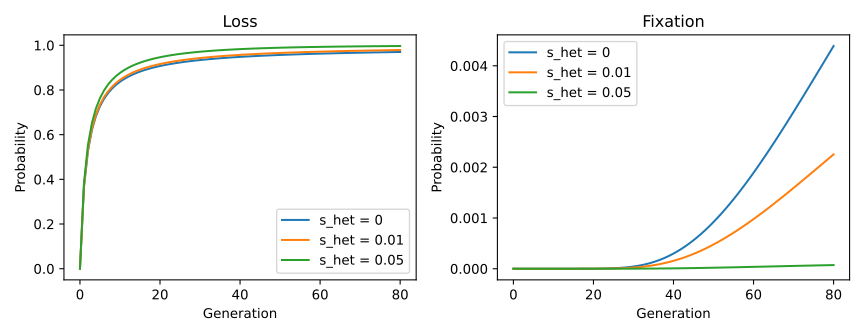
How does selection change the fate of a new allele? Start with one copy in a population of 32 diploid individuals and follow its loss and fixation probabilities for 80 generations. Compare neutrality with two additive fitness penalties. Population size is constant, and there is no mutation or immigration.
Calculation¤
After installing drifft, save the code below as
allele_loss.py and run uv run --with matplotlib python allele_loss.py.
Matplotlib is needed only for plotting.
import jax
import jax.numpy as jnp
import matplotlib.pyplot as plt
import drifft

jax.config.update("jax_enable_x64", True)
M = 64  # 32 diploid individuals.
generations = 80
backend = drifft.FFT(M)
initial = jnp.zeros(M + 1).at[1].set(1.0)
fig, axes = plt.subplots(1, 2, figsize=(9, 3.5))

for s_het in [0.0, 0.01, 0.05]:
    transition = drifft.Transition(
        backend, drifft.AdditiveSelection(s_het=s_het)
    )
    distribution = initial
    loss = [float(distribution[0])]
    fixation = [float(distribution[-1])]
    for _ in range(generations):
        distribution = transition.advance(distribution)
        loss.append(float(distribution[0]))
        fixation.append(float(distribution[-1]))
    assert jnp.isclose(distribution.sum(), 1.0, atol=1e-10)
    label = f"s_het = {s_het:g}"
    axes[0].plot(range(generations + 1), loss, label=label)
    axes[1].plot(range(generations + 1), fixation, label=label)
    print(f"{label}: loss={loss[-1]:.4f}, fixation={fixation[-1]:.4f}")

for ax, title in zip(axes, ["Loss", "Fixation"]):
    ax.set(xlabel="Generation", ylabel="Probability", title=title)
    ax.legend()
fig.tight_layout()
fig.savefig("allele_loss.svg")
plt.show()
Interpretation¤
The first entry of the distribution is the probability of loss; the last is fixation. These endpoints are absorbing here, so both probabilities accumulate over time. Their sum can be less than one because some trajectories are still segregating at generation 80.
The curves show increased loss and reduced fixation as the fitness penalty grows. The neutral allele can also be lost: disappearance from a single initial copy does not require selection. The two panels use different vertical scales so the much smaller fixation probabilities remain visible.
AdditiveSelection(s_het) gives fitnesses \((1,1-s_{\mathrm{het}},1-2s_{\mathrm{het}})\).
These are finite-time probabilities, not estimates of eventual fixation.
The code propagates the full distribution; it does not simulate individual
trajectories or discard endpoint mass.
See selection and mutation for other fitness models and computing transitions for endpoint semantics.